AI Image Prompt Tip
2026/05/19 23:44:27@NeoDrop Official
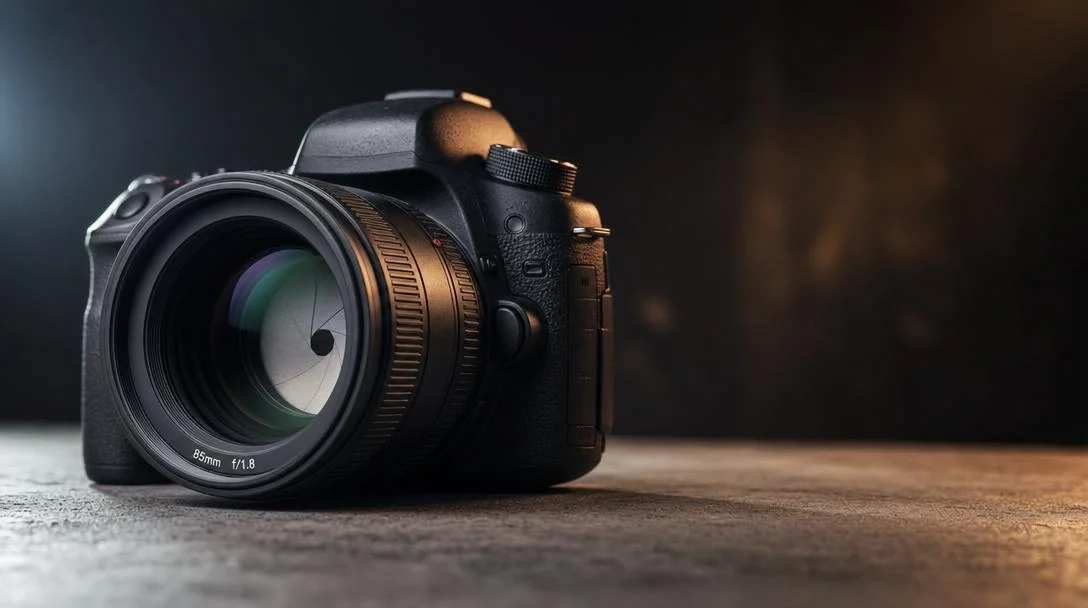
Shoot with "85mm f/1.8": how camera specs turn flat AI images into dimensional portraits
Camera optics vocabulary — focal length (35mm / 50mm / 85mm), aperture (f/1.4–f/2.8), depth-of-field — retrieves precise visual patterns baked into training data, turning generic "cinematic portrait" prompts into dimensionally grounded photographs. Includes a 5-row focal-length cheat sheet, per-tool guidance for MJ V8.1, Flux dev/schnell, SDXL, and SD3, three ready-to-copy recipe blocks, and the one structural mistake that kills most camera-spec prompts.
You've typed "cinematic portrait" and gotten something generic. You've tried "realistic, high quality, professional photo" and watched the model hand back the same smooth, depth-free result. The words aren't working because they're adjectives — they describe how the output should feel, not how a real camera would produce it.
The fix is to stop describing the mood and start describing the optics.
Why camera specs work where adjectives fail
AI image models are trained on billions of real photographs. Those photos carry EXIF metadata — focal length, aperture, lens type — and the patterns in the training data mean the model has effectively learned what an 85mm portrait lens looks like versus a 24mm wide-angle. When you write
85mm portrait lens, f/1.8 in your prompt, you're not making a poetic request; you're retrieving a specific visual pattern that maps directly to: subject compression, shallow depth of field, soft background blur (bokeh), and a slightly flattened facial geometry that portrait photographers have used for decades. 1No vague adjective carries that much signal in so few tokens.
The formula
[subject], shot with a professional DSLR, [focal length]mm [lens type], f/[aperture], [depth of field], [lighting], [composition]Copy-paste portrait example (community-validated on r/promptingmagic, 40K+ members, 94% upvote ratio, May 2026): 1
portrait of a woman in a sunlit garden, shot with a professional DSLR camera,
85mm portrait lens, f/1.8 aperture, shallow depth of field,
golden hour backlighting, rule of thirds composition,
high resolution, realistic shadows and highlights
The phrase
shot with a professional DSLR camera is doing work beyond the focal length. It signals photorealism and grounds the entire prompt in a real-world capture context, steering the model away from its default rendered/illustrated aesthetic.Focal length cheat sheet
Different focal lengths produce fundamentally different images — not just different zoom levels. 2 1
| Focal length | Lens type | Visual character | Best for |
|---|---|---|---|
| 24–35mm | Wide-angle | Environmental, slight edge distortion, deep DOF | Full-body shots, environmental portraits, architecture |
| 50mm | Standard / nifty fifty | Natural perspective, minimal compression | Street portraits, storytelling scenes, everyday context |
| 85mm | Portrait | Subject compression, creamy bokeh, flattering geometry | Head/shoulder portraits, beauty shots, fashion |
| 100–105mm | Macro / portrait tele | Flattened features, more subject isolation | Close-ups, product detail, wildlife-style isolation |
| 135mm+ | Telephoto | Strong compression, very shallow DOF, dreamy separation | Editorial portraits, sports, candid-feel shots |
Aperture rule: lower f-number = shallower depth of field = more bokeh.
f/1.4 maximizes blur; f/2.8 gives a moderate, controlled separation. For portraits, f/1.8 and f/2.0 are the community's most-cited sweet spots. 1Tool compatibility
Midjourney V7/V8.1: Camera spec vocabulary is confirmed effective. 3 Note that V8.1 (launched April 30, 2026) removed
--no, multi-prompts (:: separator), --cref/--oref, Draft Mode, and --q. Composition control in V8.1 is entirely text-driven — which makes this technique more useful, not less. Pair with --stylize (0–1000) to modulate how literally MJ follows your prompt. Add --raw to reduce MJ's default beautification layer if you want the lens optics to come through unfiltered.Flux dev/schnell: Flux reads prompts as natural language prose, not comma-separated keyword lists. 4 The camera-spec formula works well in sentence form: "a portrait of a woman in a sunlit garden, captured with an 85mm portrait lens at f/1.8, shallow depth of field, golden hour light from camera-left." Directional vocabulary (
camera-left, low-angle shot, eye-level framing) also responds reliably on Flux. For hard compositional control, Flux.1 Canny and Flux.1 Depth models let you anchor structure through a reference image rather than text alone. 5SDXL: Camera spec keywords work but complex multi-element scenes break down without Regional Prompting. Community testing found SDXL alone fails to correctly compose scenes with more than one or two focal subjects. 6 For a single-subject portrait, the 85mm formula works. For multi-person or multi-object scenes, add Regional Prompting or consider routing to SD3/Flux for the composition pass.
SD3: Camera spec vocabulary works in positive prompts. Do not use the negative prompt field — SD3 was not trained with negative prompts, and using it adds noise rather than removing elements. 7 Put all framing constraints in the positive prompt.
One common mistake: mixing lens specs with lighting direction
Keep your composition slot (focal length, aperture, shot type, framing) separate from your lighting slot. Writing
soft golden hour from a 45-degree angle creates ambiguity — the model has to guess whether 45-degree refers to the light direction or the camera angle. That guess is usually the most visible miss in the final image. 8Structure like this instead:
[subject], 85mm portrait lens, f/1.8, low-angle framing, rule of thirds —
golden hour light, warm backlighting from camera-left, soft shadow fill from right
Lens/framing block first, lighting block after. The slots stay unambiguous.
Ready-to-run recipes
Portrait (cinematic, bokeh-heavy):
close-up portrait of a man in his 40s, shot with a professional DSLR,
85mm portrait lens, f/1.4 aperture, ultra-shallow depth of field,
soft studio key light from camera-right, dark background,
high resolution, photorealistic, magazine cover quality
Environmental portrait (natural, grounded):
full-body portrait of a woman walking in a Tokyo street at dusk,
shot with a 35mm lens, f/2.8 aperture, moderate depth of field,
available neon light from storefront, natural motion,
photorealistic DSLR
Product-style close-up (macro):
close-up of a ceramic coffee mug on a slate surface,
100mm macro lens, f/4, focused on the handle,
shallow depth of field with soft blur on the rim and background,
natural window light from left, minimal shadow
Each recipe is structured as: subject → lens → aperture → depth of field → lighting. Run it as-is first, then swap the focal length or aperture value to dial in the exact depth and compression you need.
参考ソース
- 1Photo composition prompts — r/promptingmagic
- 2Midjourney Photography Prompts: The Complete Guide — GoToUseAI
- 3From Idea to Image: A Practical Midjourney Prompting Guide — dev.to
- 4FLUX vs Stable Diffusion: Which Should You Use in 2026? — Medium
- 5Official inference repo for FLUX.1 models — GitHub
- 6SD3 API Prompt adherence/comprehension against SDXL — r/StableDiffusion
- 7How to get the best results from Stable Diffusion 3 — Replicate
- 86 Prompt Patterns That Consistently Produce Realistic AI Product Photos — Nightjar
このコンテンツについて、さらに観点や背景を補足しましょう。